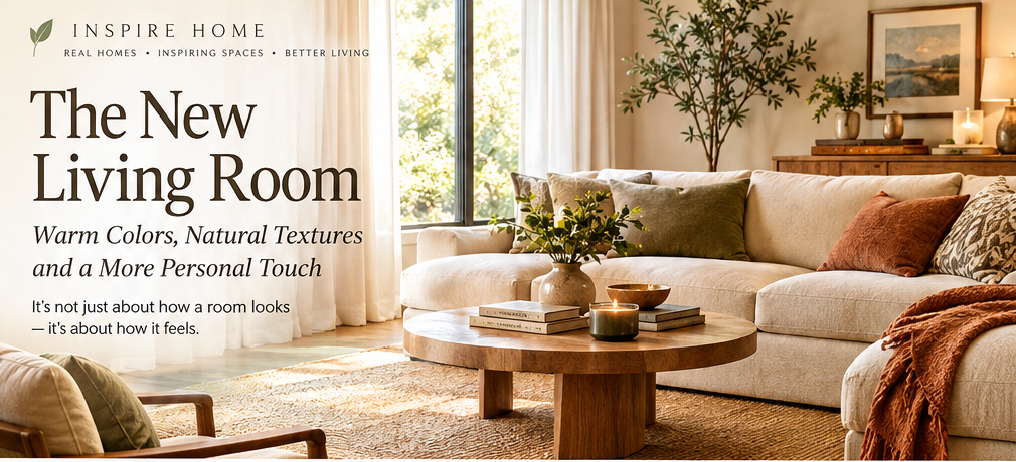
Warm colors, natural textures, and a home that feels lived in
There was a time when the perfect living room seemed to have one very important rule:
Nobody was actually supposed to live in it.
The cushions were perfectly arranged. The coffee table was spotless. Everything matched.
The room looked beautiful in photographs, but somehow you could imagine being afraid to put your feet up.
That look is changing.
The living rooms emerging in 2026 are warmer, softer and more personal. Designers are moving away from stark minimalism and overly coordinated rooms and toward spaces with natural materials, layered textures, curved furniture, richer colors and pieces that look as though they were collected rather than ordered in one afternoon.
And I think there is something bigger happening here.
We aren’t simply changing the way our living rooms look.
We’re changing what we want home to feel like.
1. Warm Colors Are Taking the Place of Cold Neutrals
For years, gray was practically the uniform of modern decorating.
Gray walls. Gray sofa. Gray rug.
Very sophisticated.
Also, occasionally, about as emotionally exciting as a dentist’s waiting room.
In 2026, designers are leaning toward warmer neutrals such as mushroom, taupe, caramel, creamy white, clay, terracotta and warm brown, often mixed with muted greens and other nature-inspired shades. Houzz reports that warm wood tones, earthy colors and layered textures are becoming a foundation of current home design rather than simply another passing trend.
The beauty of these colors is that they don’t demand attention.
They create an atmosphere.
A warm ivory wall beside natural wood feels different from a bright white wall beside gray furniture. Add an olive-green cushion or a little terracotta and suddenly the room has depth without becoming loud.
You don’t have to repaint the entire house, either.
Sometimes the easiest way to introduce the trend is through pillows, throws, artwork or a rug.
Try this palette:
Cream + warm beige + natural wood + olive + one small hit of terracotta.
That’s enough.
Shop the color story:
Browse warm neutral living-room décor on Amazon
2. Texture Is the Secret Ingredient
Here’s something interesting about the new neutral rooms:
They’re not necessarily more colorful.
They’re more textured.
Linen.
Wool.
Bouclé.
Rattan.
Woven fibers.
Wood.
Stone.
Ceramic.
When the colors are quiet, texture becomes what keeps the room from feeling flat.
Think about the difference between a room filled with smooth beige surfaces and one with a linen curtain, a chunky throw, a woven rug, a rough ceramic vase and a wooden table with visible grain.
Same basic color family.
Completely different feeling.
And you don’t need ten new accessories.
One beautiful textured throw can do more than five decorative objects.
Texture is what gives a quiet room its personality.
Shop the texture:
Browse textured neutral throw blankets on Amazon
3. Curves Are Making Rooms Feel Softer
The straight lines of modern furniture are getting a little company.
Curved sofas.
Rounded chairs.
Circular coffee tables.
Arched lamps.
Organic-shaped mirrors.
Curved furniture continues to be one of the prominent 2026 directions, with designers connecting softer silhouettes to more relaxed, conversational rooms.
And you don’t need a curved sofa to get the effect.
A single rounded chair can change the geometry of an entire room.
Imagine a traditional sofa with a round coffee table and a softly curved accent chair.
Suddenly the room isn’t a collection of rectangles.
It has movement.
It feels easier.
Shop the curves:
Browse curved and bouclé accent chairs on Amazon
4. The Coffee Table Has Become More Interesting
The coffee table used to be furniture.
Now it’s part of the composition.
Round and organic shapes are particularly useful because they break up the straight lines created by sofas, walls and cabinets.
Natural wood adds another layer of warmth.
And a substantial wooden table can become the visual anchor of a room without looking overly formal.
The trick is not to cover it with stuff.
Try a stack of books, a simple ceramic bowl and something living — perhaps a small branch or plant.
Then stop.
The table should still be a table.
Shop the look:
Browse round natural-wood coffee tables on Amazon
5. Collected Is Better Than Coordinated
This may be my favorite trend.
The most interesting rooms aren’t necessarily the ones where every piece matches.
They’re the ones where things belong together without being identical.
A modern sofa might sit beside an antique-looking wooden cabinet.
A contemporary lamp might illuminate an old framed painting.
A vintage-looking bowl might sit on a brand-new coffee table.
Designers are increasingly embracing combinations of different eras, shapes, scales and materials because they create the impression that a room developed naturally over time rather than being purchased as one matching set.
And that makes sense.
When everything matches, you see the decorating.
When things have a little history and contrast, you see the person.
That’s the difference between a room that is decorated and a room that has a story.
Shop collected-style décor:
Browse vintage-inspired living-room décor on Amazon
6. The Living Room Is Becoming Less About the Television
Here’s a change that has nothing to do with color.
It’s about where we put the furniture.
Instead of automatically pointing every chair toward the television, designers are creating more conversation-centered layouts.
A sofa faces two chairs.
A round coffee table sits between them.
A reading chair occupies a sunny corner.
The television can still be there.
It just doesn’t have to be the most important object in the room.
Curved furniture and defined seating zones can make rooms feel more intimate, particularly in open-plan spaces. Designers are also emphasizing layouts that support multiple ways of using a room rather than one fixed purpose.
Think about what you actually want your living room to do.
Watch television?
Read?
Have coffee with a friend?
Stretch out on Sunday morning?
Have people linger after dinner?
The best layout starts there.
Not with the television.
Shop pieces for a conversation-friendly room:
Browse living-room accent chairs and seating on Amazon
7. Natural Materials Are Bringing the Outdoors In
Wood has returned with confidence.
Stone is getting more attention.
Woven materials are everywhere.
Plants are becoming larger and more architectural.
And natural light matters.
This connects with the continuing movement toward biophilic design — creating stronger visual and sensory connections with nature through materials, plants, light and organic forms. Current 2026 design reporting identifies natural wood, stone, indoor planting and earthy palettes as important elements of this direction.
You don’t have to turn your living room into a jungle.
One large plant can be enough.
A wooden table can be enough.
A stone bowl can be enough.
A linen curtain moving slightly in an open window can be enough.
The point isn’t to decorate with nature.
It’s to make the room feel connected to it.
Bring in a little green:
Browse indoor olive trees and greenery on Amazon
8. A Little Imperfection Makes a Room Feel Authentic
There is another trend hiding underneath all of these trends.
People seem to be getting tired of rooms that look as though nobody is allowed to touch anything.
Current design reporting describes a move toward warmer, more personalized interiors and a “collected-over-time” look, with vintage pieces, natural materials and objects that have character taking the place of showroom perfection.
Maybe that’s why an old wooden table can feel more beautiful than a flawless new one.
Why handmade-looking ceramics are appealing.
Why a slightly imperfect vintage frame can make a wall more interesting.
Why a throw casually left on the sofa can actually improve the room.
A beautiful home shouldn’t have to look untouched.
A little evidence of life is not clutter.
Sometimes it’s character.
Add something with character:
Browse textured ceramic vases and pottery décor on Amazon
How to Bring the Look Home Without Starting Over
The good news is that you don’t need to replace your living room.
In fact, replacing everything might give you exactly the look we’re moving away from.
Instead, change the layers.
Keep what still works.
If your sofa is comfortable and you love it, keep it.
Add one strong natural element.
A wood coffee table, woven rug or large plant can change the entire feeling of a room.
Introduce texture.
Try linen, bouclé, wool or a chunky woven throw.
Bring in one deeper color.
Olive, rust, chocolate brown or muted clay can keep warm neutrals from becoming monotonous.
Change the shape.
If everything in the room has straight lines, introduce something round.
Then remove something.
This may be the hardest part.
Not every surface needs to be decorated.
A little empty space gives beautiful things somewhere to breathe.
The Real Trend Isn’t Beige
After looking at all these trends, I don’t think the biggest story is actually about color.
Or curves.
Or coffee tables.
Or even natural materials.
The deeper change is that perfect is becoming less interesting than personal.
We want rooms that can handle a cup of coffee.
A dog on the rug.
A book left open.
Friends staying longer than expected.
A Sunday afternoon with nowhere to go.
We want beauty, but we also want comfort.
And perhaps that’s why the new living room feels so different.
It’s not asking:
“Does this room look impressive?”
It’s asking:
“Do you want to stay awhile?”
The most beautiful room isn’t the one that looks perfect. It’s the one that makes you want to stay.